Free resources
ICSE Grade 8 sample papers, worksheets and mind maps, with answer keys, to download and print. No account needed.
History & Civics term paper
Full syllabus · 80 marks · 6 pages, with an answer key
Paper: PDF, 3.0 MB · Answer key: PDF, 4.5 MB · Updated for 2026–2027
Three questions from the paper, with answers
Question 1 · MCQ
In 1919, shops in many towns of Punjab stayed shut for a whole day to protest against a new law that let the government jail people without trial. What is this kind of protest called, and which law was it against? [1]
Question 2 · Short answer (Civics)
Explain the veto power of the permanent members of the Security Council. What happens when the Security Council cannot take any action because of the veto? [2]
Answer: Decisions in the Security Council are taken by a majority vote of at least nine members, including all the five permanent members. A negative vote by any one of the permanent members would lead to a cancellation of the resolution. This right to prevent action being taken is known as the right to veto. This means that any resolution becomes ineffective even if one of the permanent members votes against it.
When no action can be taken by the Security Council because of the veto, the General Assembly can deal with the crisis. It can take whatever action may seem appropriate to restore and maintain world peace.
Question 3 · Source-based question (History)
A Sikh soldier writes in 1846: “Since our Maharaja died, our chiefs have been fighting one another for power, and now the British are marching against us.” Name the Maharaja, and explain how the situation he describes ended by 1849. [2]
Answer: The Maharaja was Ranjit Singh, under whose leadership the Sikh kingdom had become very powerful and independent. After his death the kingdom was torn by internal strife and a struggle for power, and the British used this opportunity to strike. They fought two Anglo‑Sikh Wars (1845–49). The Sikhs fought fiercely to keep their freedom but suffered a decisive loss, and Lord Dalhousie annexed Punjab in 1849.
History & Civics worksheet
Union Legislature · 15 marks · 3 pages, with an answer key
Worksheet: PDF, 1.5 MB · Answer key: PDF, 1.5 MB · Updated for 2026–2027
Two questions from the worksheet, with answers
Question 1 · Picture-based MCQ
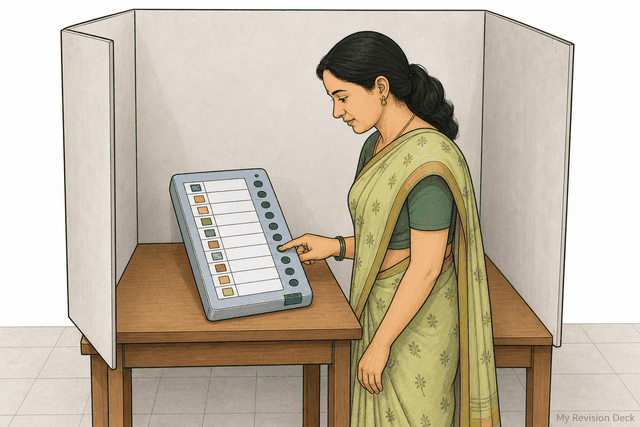
Observe the image of a voter using an Electronic Voting Machine. Which of the given options best states how the Electronic Voting Machine helps voters? [1]
Question 2 · Match the columns
Match Column A with Column B. [3]
| Column A | Column B |
|---|---|
| (a) Lok Sabha | (i) Their elected members choose most Rajya Sabha members |
| (b) State Legislative Assemblies | (ii) Branch of government that makes the laws of the country |
| (c) Legislature | (iii) Lower House of Parliament |
Answer: (a) → (iii) · (b) → (i) · (c) → (ii)
History & Civics mind map
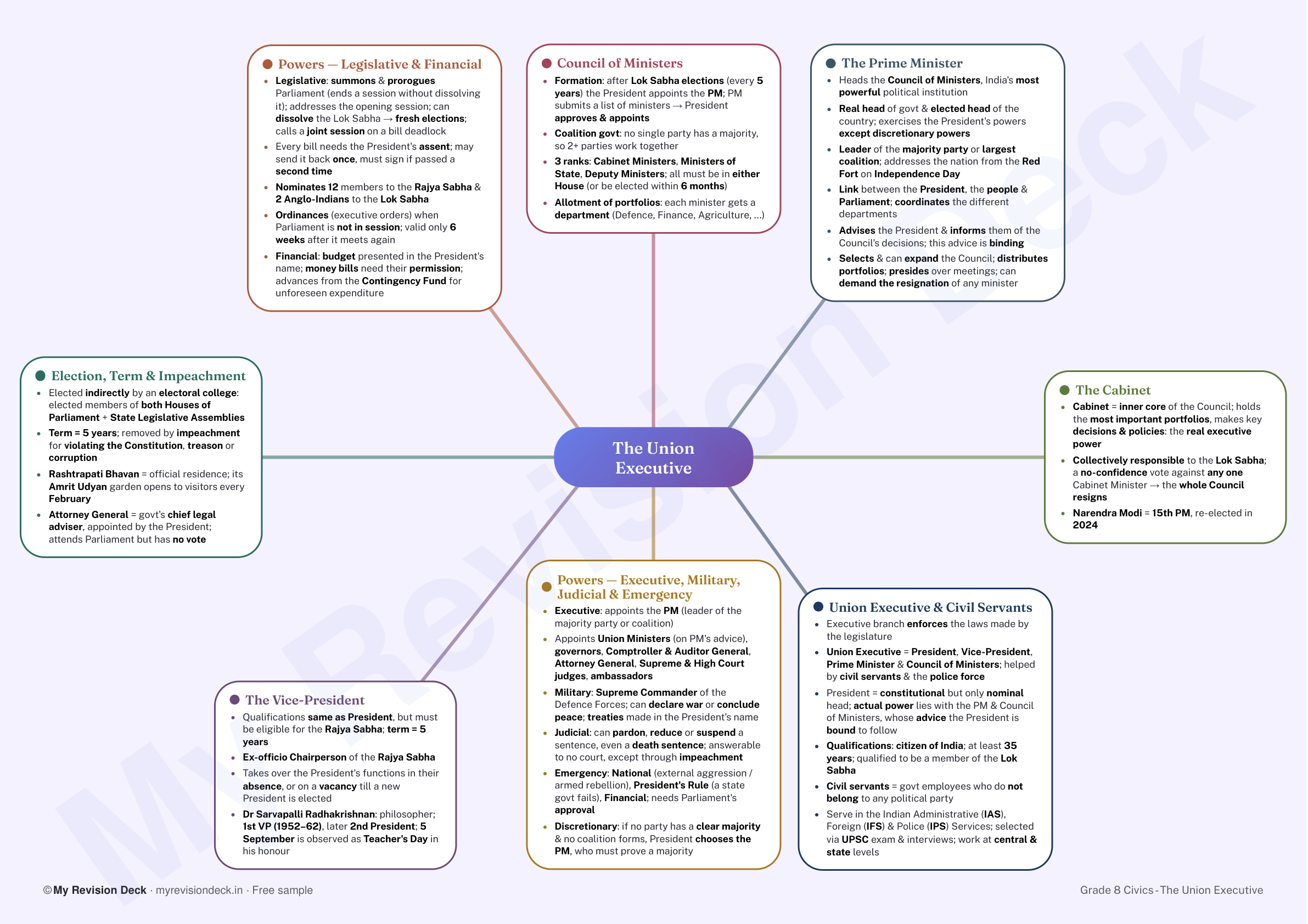
The Union Executive · 1 page, A3, to print or keep on screen
PDF, 253 KB · 1 page, A3
Click the mind map to see it full size.
Geography term paper
Full syllabus · 80 marks · 7 pages, with an answer key
Paper: PDF, 3.5 MB · Answer key: PDF, 5.4 MB · Updated for 2026–2027
Three questions from the paper, with answers
Question 1 · Picture-based MCQ
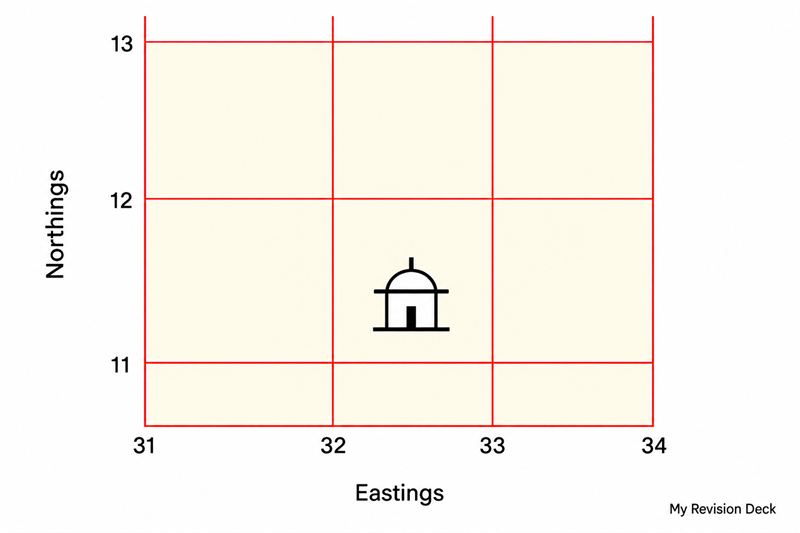
Observe the grid diagram shown. Which of the given options best gives the four‑figure grid reference of the temple? [1]
Question 2 · Geographical reason
Give geographical reasons for the following:
Forest fires, especially in rainforests, have become a global hazard. [1]
Answer: Forest fires release large amounts of greenhouse gases into the atmosphere and cause global warming and climate change. Large fire events can also create acid rain conditions that further damage forest habitat, while the smoke and smog produced decrease the amount of sunlight and induce respiratory problems in wildlife.
Question 3 · Picture-based question
Study the image of floods in a southern state of India and answer the questions that follow. [3]
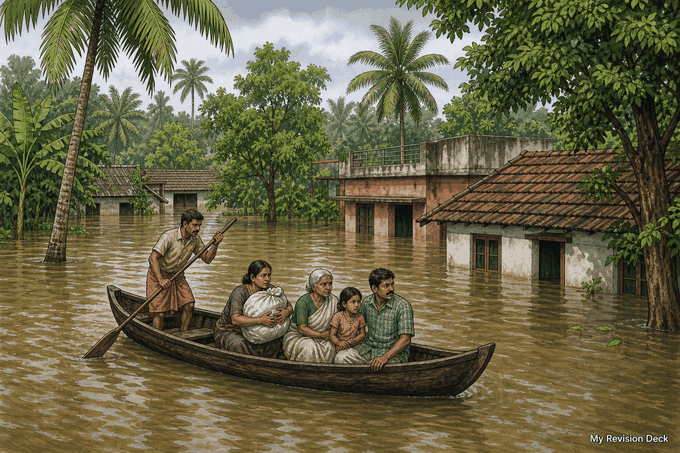
(a) Identify the Indian state in which this evacuation is taking place, and the year in which it happened. [1]
(b) Describe the impact of these floods. [2]
Answer: (a) The evacuation is taking place in Kerala, during the floods of August 2018.
(b) The floods in Kerala in August 2018 caused immeasurable misery and devastation. Hundreds of lives were lost. Thousands of homes were totally destroyed and many more were damaged. Hundreds of villages were affected and thousands of kilometres of roads were destroyed. According to the Kerala State Government, the total losses were estimated at around Rs. 40,000 crores.
Geography worksheet
Disasters · 15 marks · 3 pages, with an answer key
Worksheet: PDF, 1.5 MB · Answer key: PDF, 1.5 MB · Updated for 2026–2027
Two questions from the worksheet, with answers
Question 1 · Picture-based MCQ
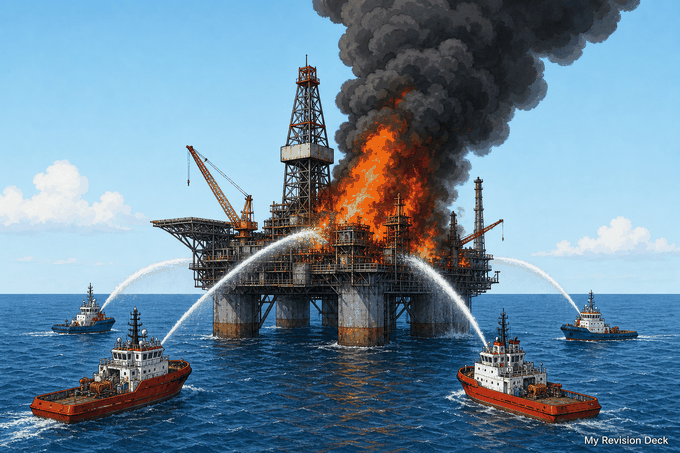
Observe the image. Which of the given options best names the oil spill that began with the event shown? [1]
Question 2 · Geographical reason
Give geographical reasons for the following:
Mock drills are an essential part of disaster preparedness. [1]
Answer: Mock drill training and practice form the practical side of disaster preparedness, alongside warning systems and educating people to cope with a disaster and keep a survival kit. Organising mock drills in schools, colleges and offices prepares people for any eventuality, so that more loss of life and property can be avoided when a disaster occurs.
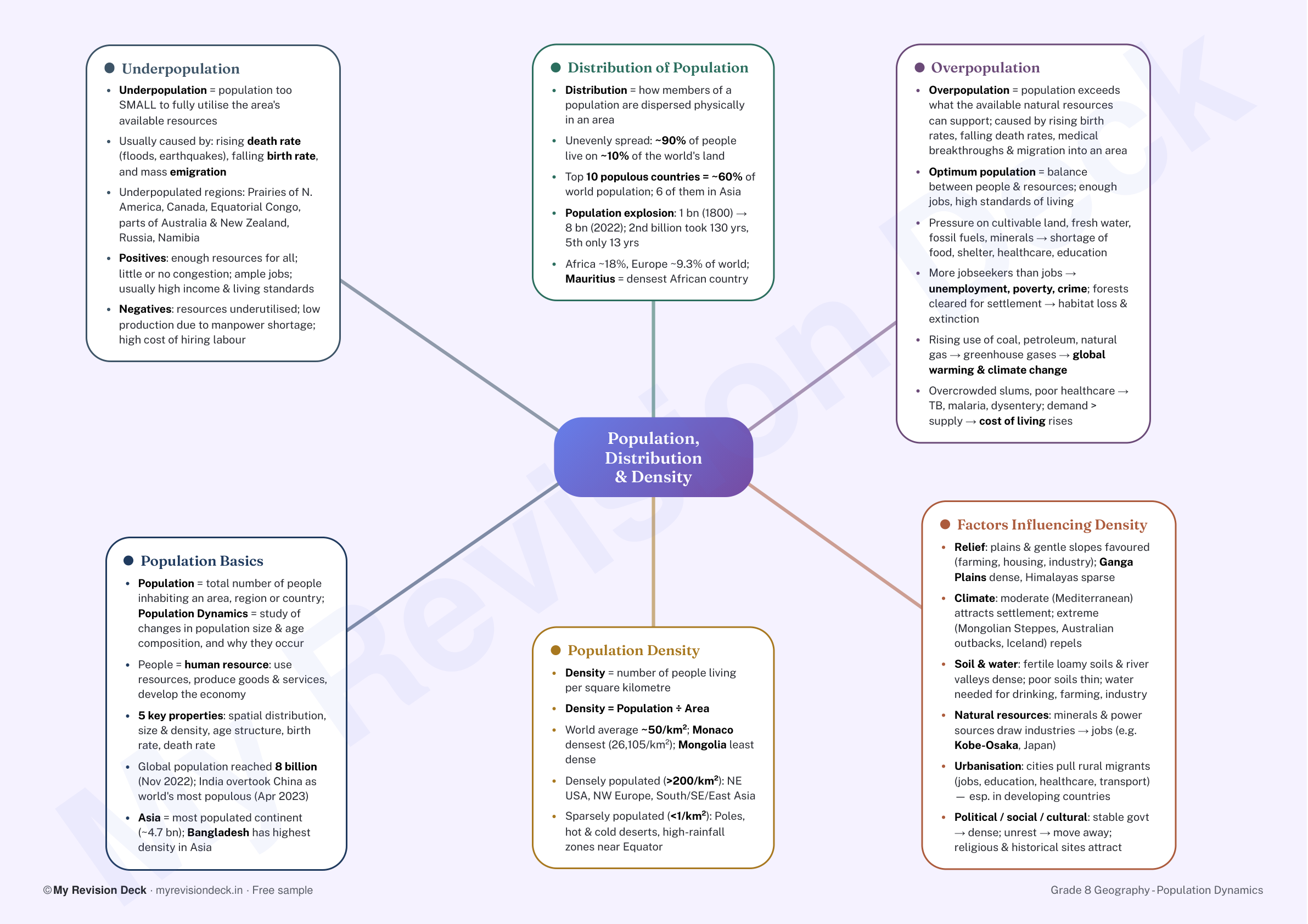
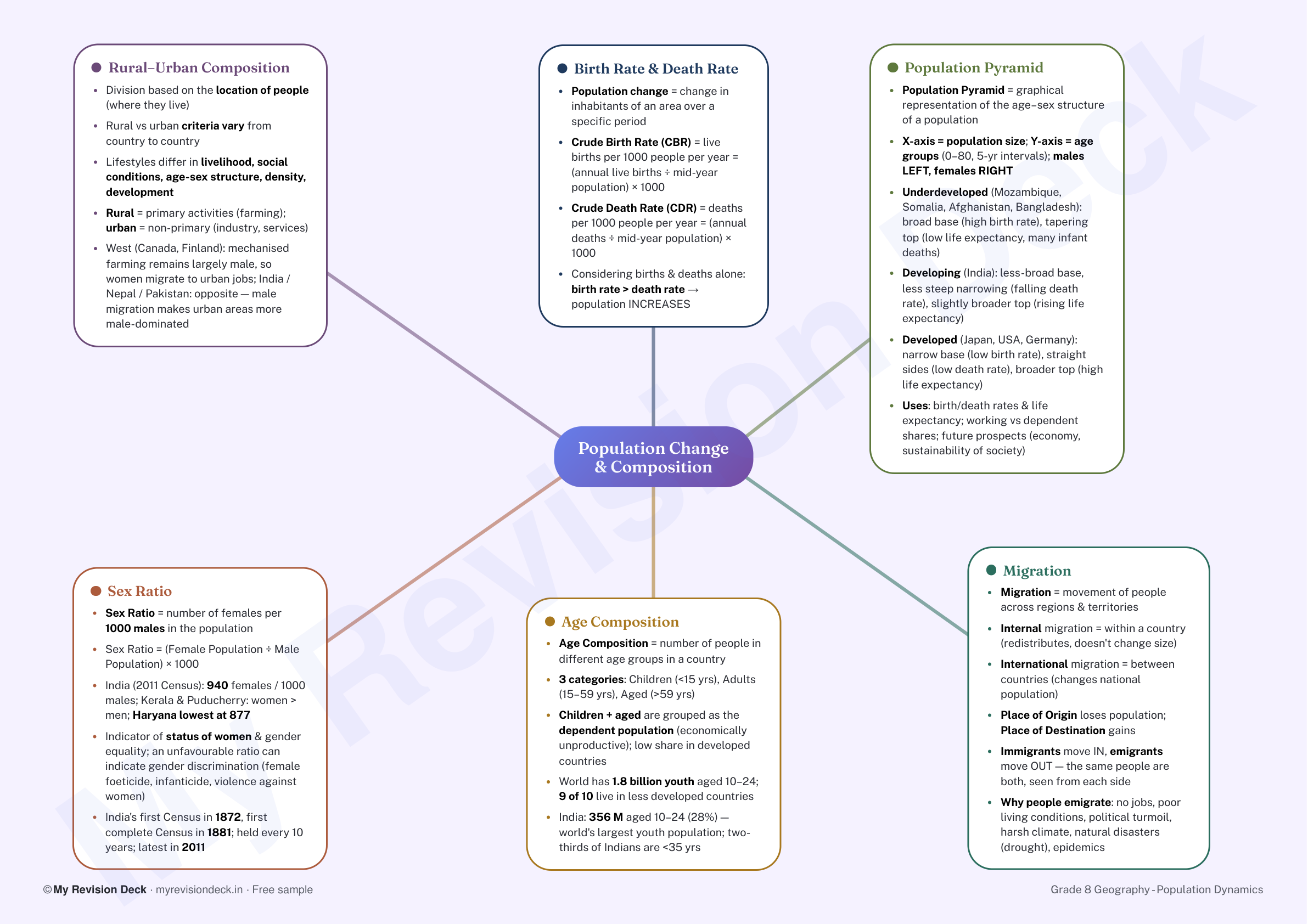
Geography mind map
Population Dynamics · 2 pages, A3, to print or keep on screen
PDF, 268 KB · 2 pages, A3
Click the mind map to see it full size.
Physics term paper
Full syllabus · 80 marks · 8 pages, with an answer key
Paper: PDF, 4.5 MB · Answer key: PDF, 6.6 MB · Updated for 2026–2027
Three questions from the paper, with answers
Question 1 · Picture-based MCQ
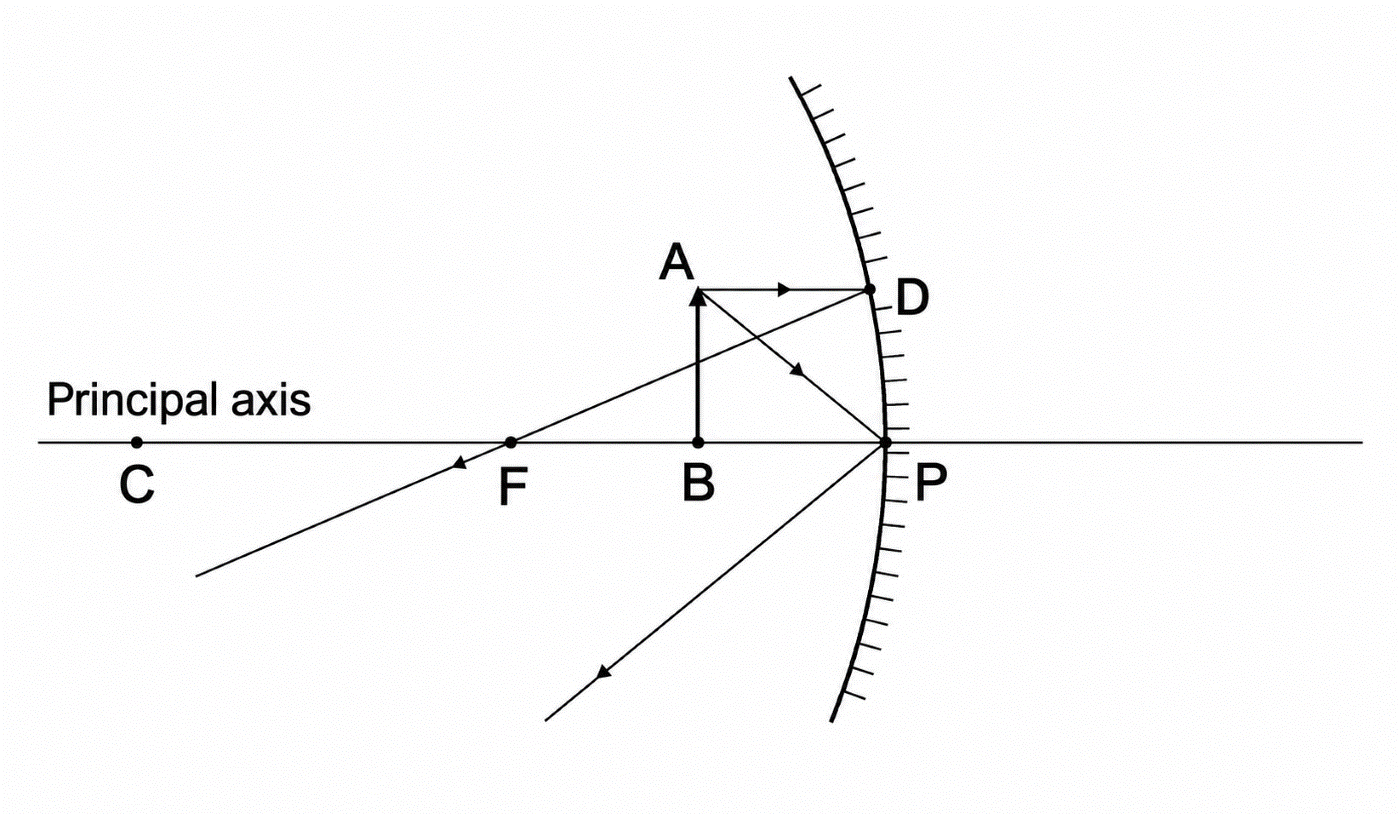
Observe the diagram showing two rays from the tip A of an object AB placed between the principal focus F and the pole P of a concave mirror, and the rays after reflection. Which of the given options best describes the image of AB formed by the mirror? [1]
Question 2 · Reasoning MCQ
Two coolies, A and B, lift the same load to the same height. Coolie A does it in 1 minute and coolie B does it in 2 minutes. Which of the following is true? [1]
Question 3 · Numerical
A piece of iron of mass 195 g is immersed in water taken in a Eureka can. It displaces 25 mL of water. Find the density of iron in kg m⁻³. [3]
Answer: Density = 7800 kg m⁻³.
Volume of iron = volume of water displaced = 25 mL = 25 cm³.
Formula: density = mass / volume.
Density = 195 / 25 = 7.8 g cm⁻³.
Conversion: 1 g cm⁻³ = 1000 kg m⁻³, so density = 7.8 × 1000 = 7800 kg m⁻³.
Physics worksheet
Force & Pressure · 15 marks · 3 pages, with an answer key
Worksheet: PDF, 1.3 MB · Answer key: PDF, 1.3 MB · Updated for 2026–2027
Two questions from the worksheet, with answers
Question 1 · Picture-based MCQ
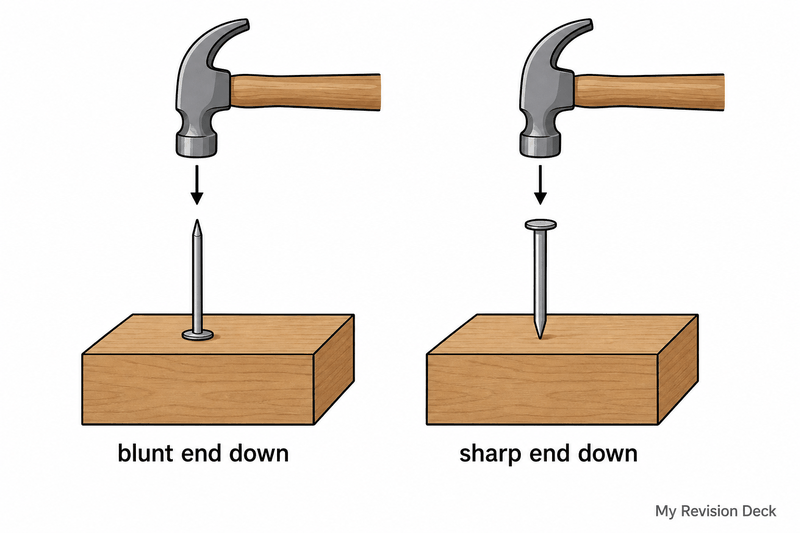
The image shows two identical hammers striking two nails with equal force — one nail is held with its flat blunt end on the wooden block, while the other is held with its sharp end on the block. Which nail enters the block, and why? [1]
Question 2 · Numerical
The thrust on the bottom of a swimming pool of area 200 m² is 1.5 × 10⁶ N. Calculate the pressure on the bottom of the pool in Pa, and the pressure in kPa. [3]
Answer: Pressure = 7500 Pa = 7.5 kPa.
Formula: pressure P = F / A.
P = 1.5 × 10⁶ N / 200 m² = 7500 N m⁻² = 7500 Pa.
In kPa: P = 7500 Pa ÷ 1000 = 7.5 kPa.
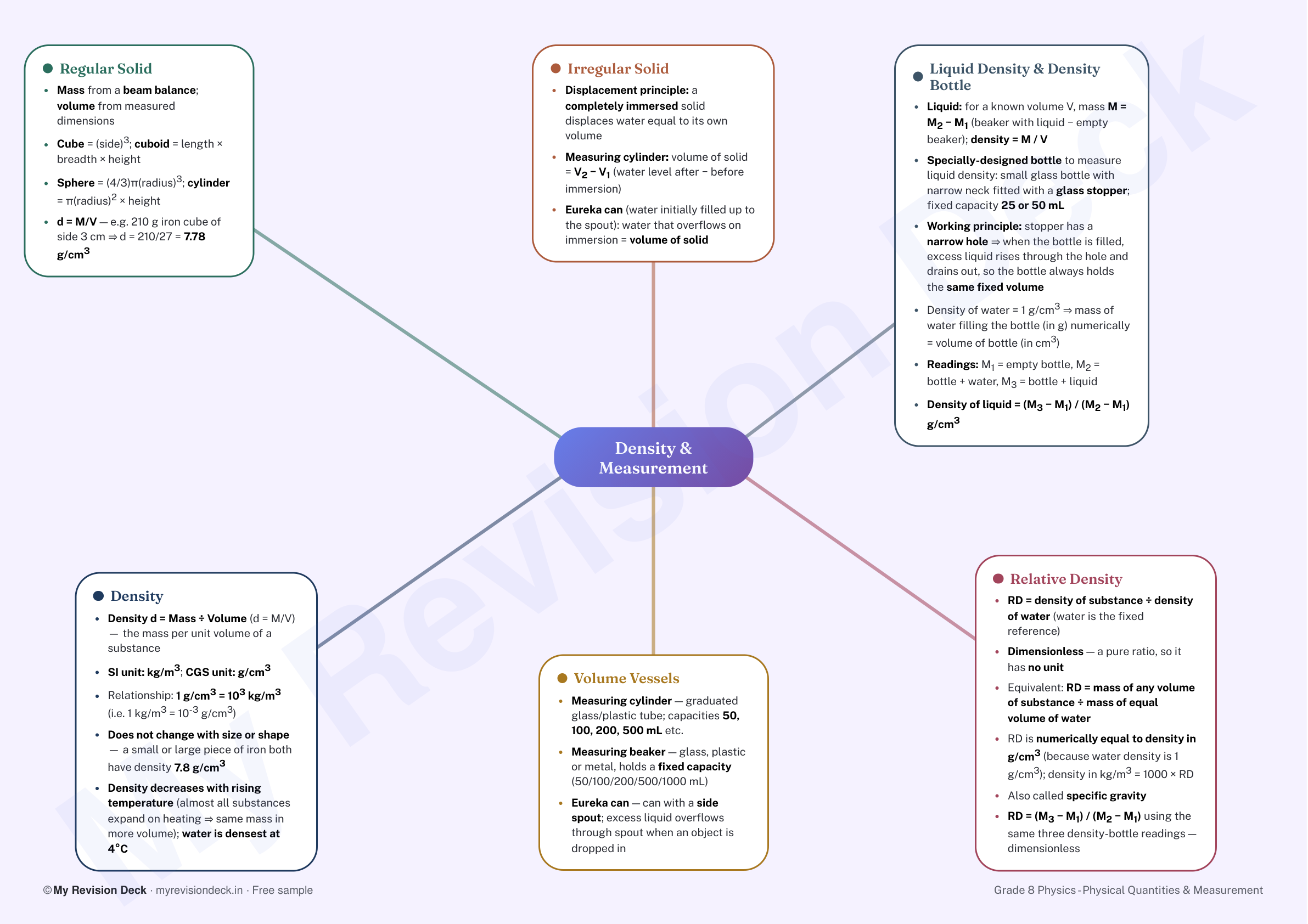
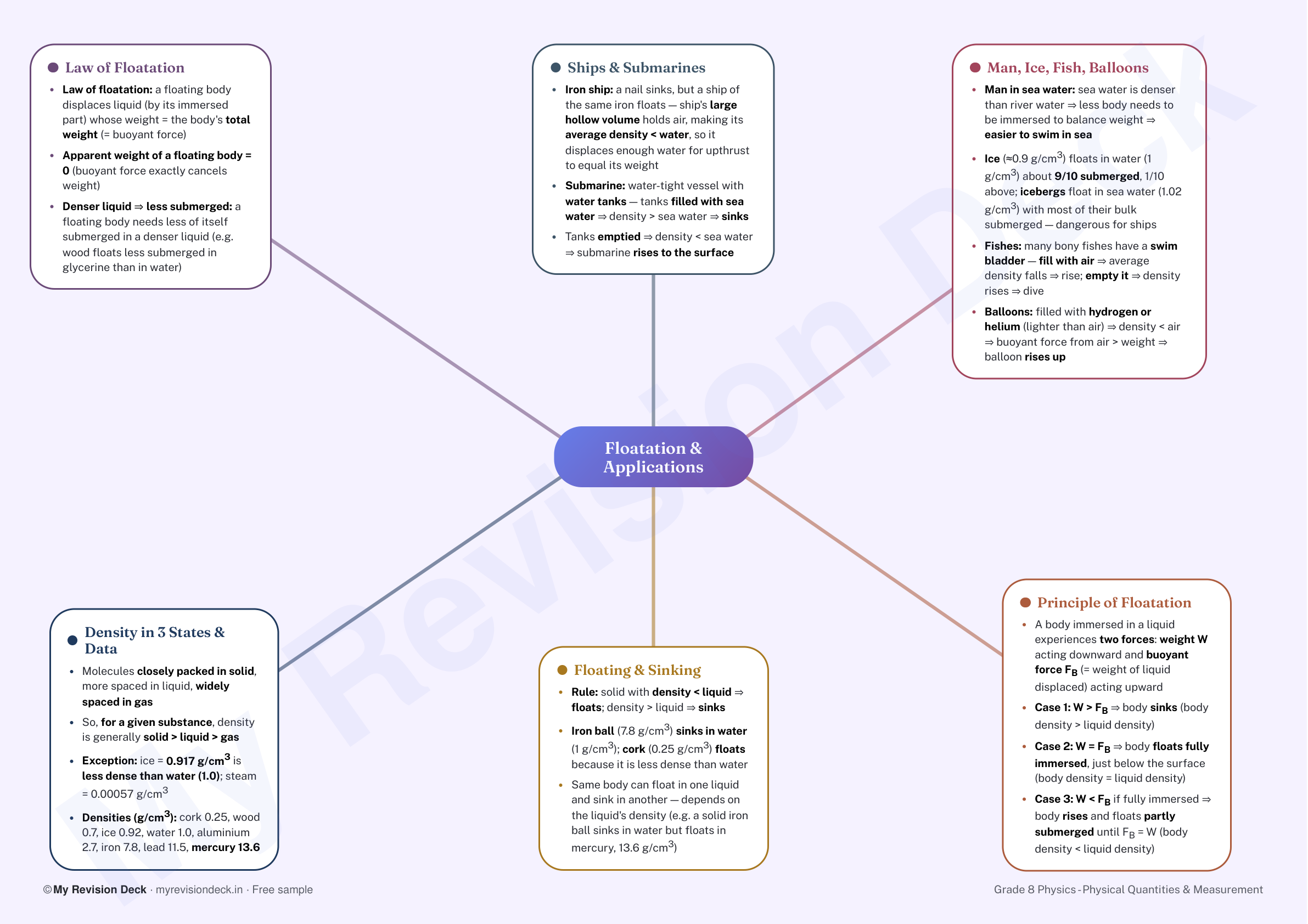
Physics mind map
Physical Quantities & Measurement · 2 pages, A3, to print or keep on screen
PDF, 290 KB · 2 pages, A3
Click the mind map to see it full size.
Chemistry term paper
Full syllabus · 80 marks · 8 pages, with an answer key
Paper: PDF, 3.8 MB · Answer key: PDF, 5.4 MB · Updated for 2026–2027
Three questions from the paper, with answers
Question 1 · Picture-based MCQ
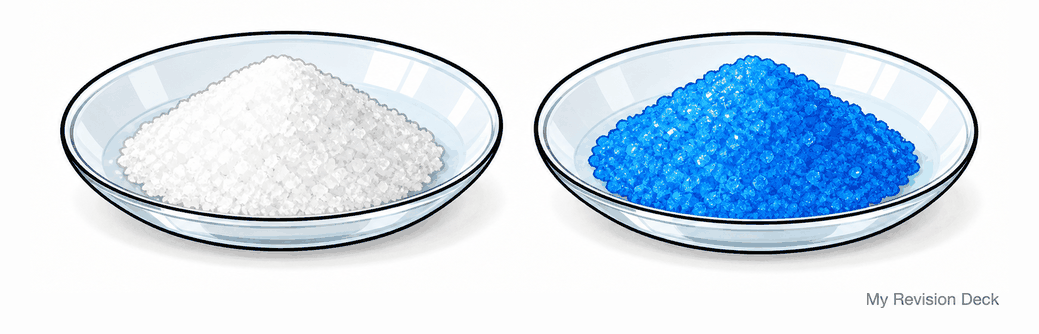
Observe the image showing two samples of copper sulphate side by side — one is white and the other is blue. Which of the given options best identifies the two samples? [1]
Question 2 · Application MCQ
Riya heats some sugar in a pan. First it melts into a clear syrup, then it turns brown and gives off a burnt smell. On cooling, the brown mass becomes hard. Which of these shows that a chemical change has taken place? [1]
Question 3 · Application question
Hot rice is packed in a steel tiffin box and the lid is closed. When the box is opened at lunch time, drops of water are seen on the underside of the lid. Name the two changes of state that have taken place and explain each of them in terms of the particles of water. [3]
Answer: The two changes are evaporation and condensation.
First, water evaporates from the hot rice: some of the water particles at the surface move fast enough to overcome the attraction of the neighbouring particles and escape as water vapour into the closed box.
Then condensation takes place at the lid, which cools faster than the rice: when the vapour touches the cooler lid, it loses heat, its particles lose energy and slow down, and they come close together again to form drops of liquid water on the underside of the lid.
Chemistry worksheet
Physical & Chemical Changes · 15 marks · 3 pages, with an answer key
Worksheet: PDF, 1.3 MB · Answer key: PDF, 1.3 MB · Updated for 2026–2027
Two questions from the worksheet, with answers
Question 1 · MCQ
The change from day to night and the change of seasons are examples of which type of change? [1]
Question 2 · Picture-based question
Answer the questions below based on the given laboratory setup shown in the diagram. [5]
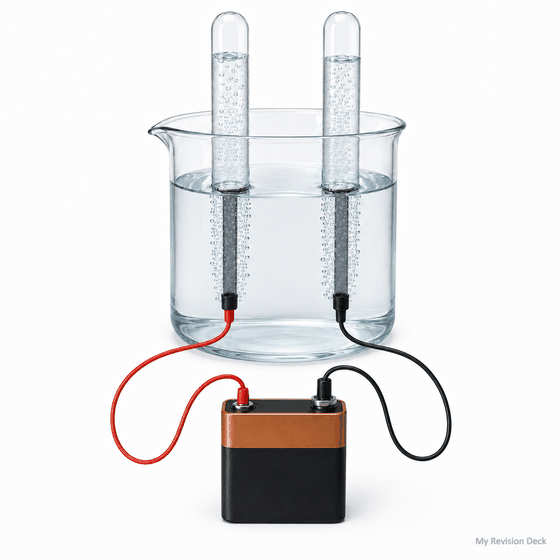
(i) Name the process illustrated by this apparatus. [1]
(ii) What type of energy is supplied by the battery to drive this process? [1]
(iii) Name the two gases produced during this process. [1]
(iv) Is the process shown a physical change or a chemical change? [1]
(v) Justify your answer to the previous question with one reason. [1]
Answer: (i) The process shown is electrolysis.
(ii) Electrical energy is supplied by the battery.
(iii) The two gases produced are hydrogen and oxygen.
(iv) The process shown is a chemical change.
(v) Water is decomposed and new substances are formed, which shows that this is a chemical change.
Chemistry mind map
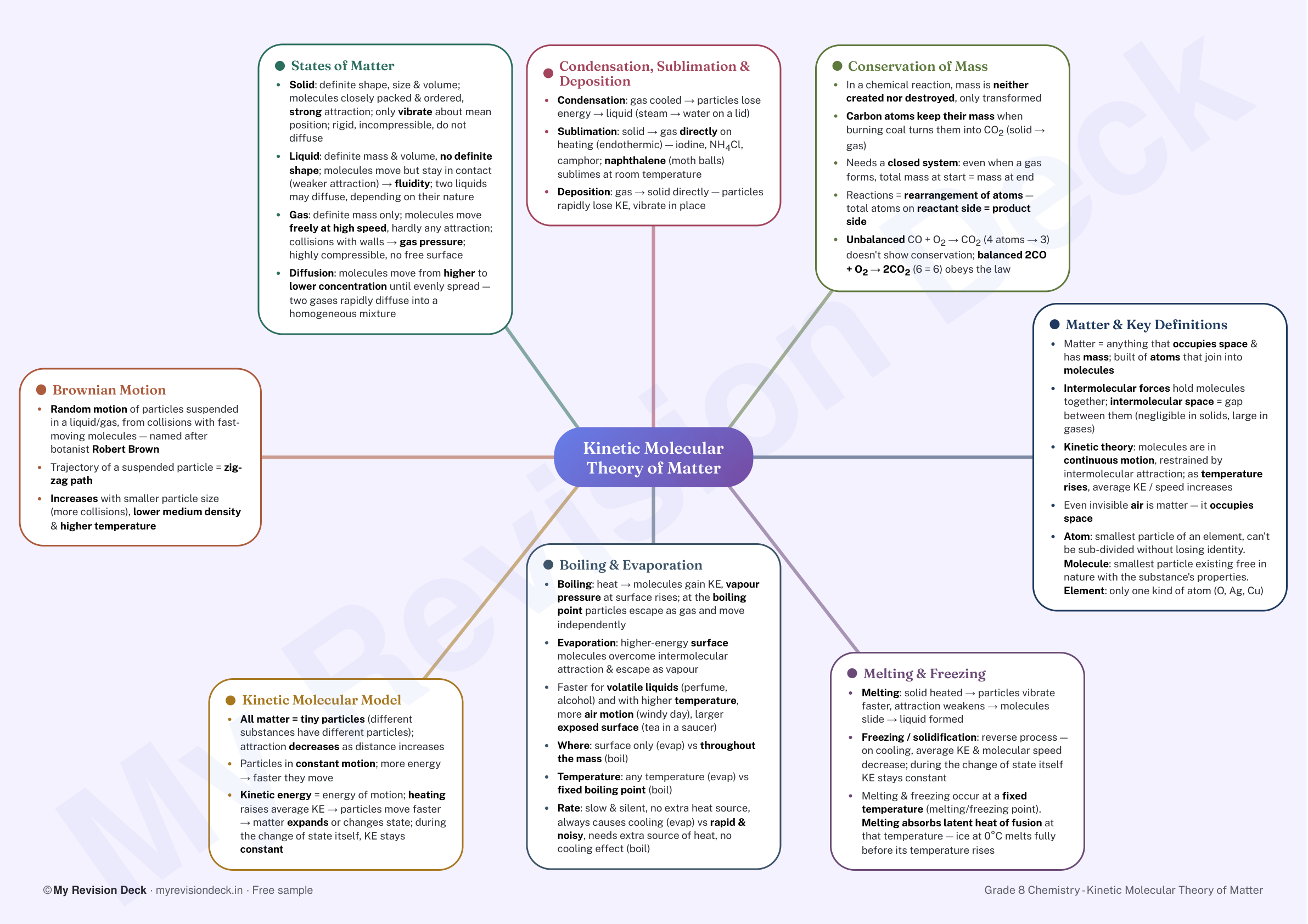
Kinetic Molecular Theory of Matter · 1 page, A3, to print or keep on screen
PDF, 244 KB · 1 page, A3
Click the mind map to see it full size.
Biology term paper
Full syllabus · 80 marks · 8 pages, with an answer key
Paper: PDF, 4.1 MB · Answer key: PDF, 5.8 MB · Updated for 2026–2027
Three questions from the paper, with answers
Question 1 · Label the diagram
Label the parts of the human heart shown in the internal structure diagram. [5]
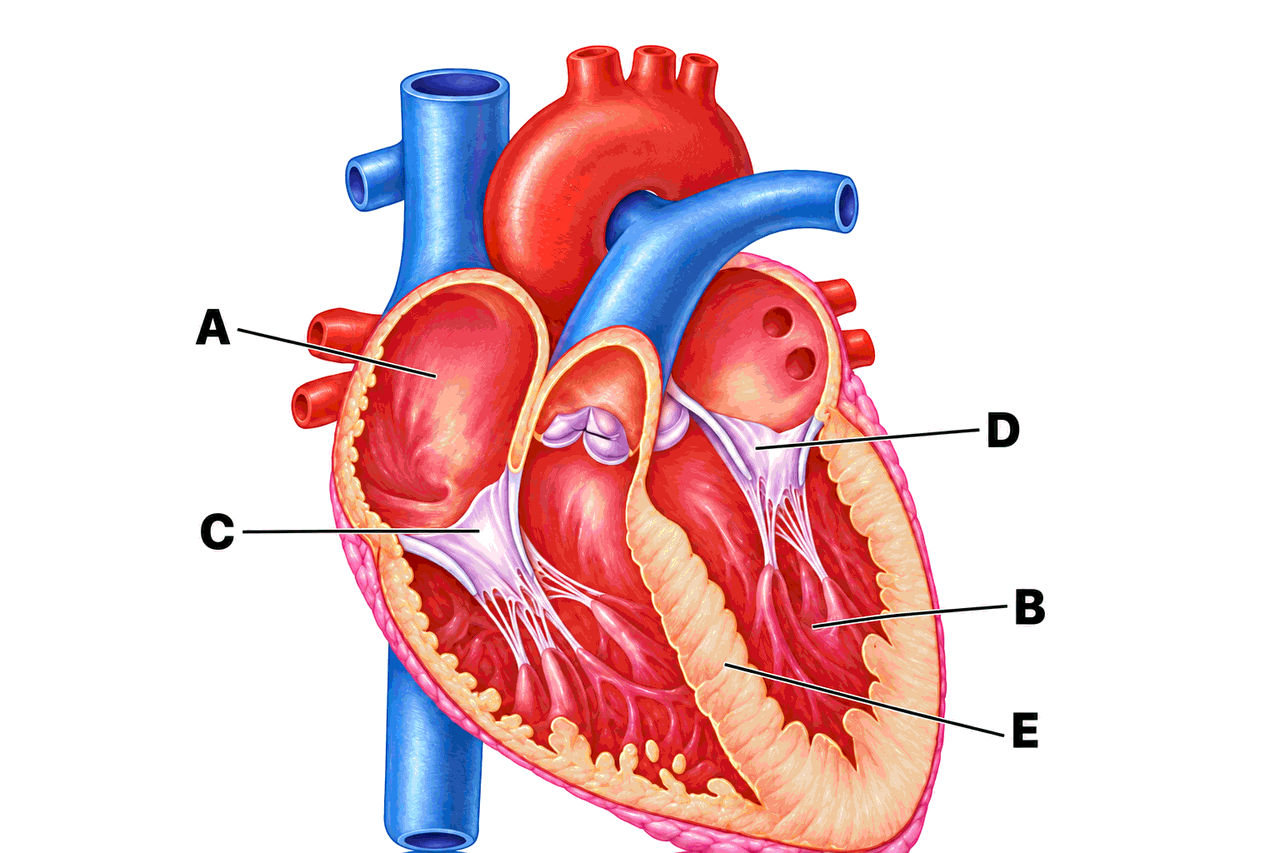
(a) Label A [1]
(b) Label B [1]
(c) Label C [1]
(d) Label D [1]
(e) Label E [1]
Answer: (a) Right atrium · (b) Left ventricle · (c) Tricuspid valve · (d) Bicuspid valve · (e) Septum
Question 2 · Odd one out
Choose the odd one out from the following terms and name the category to which the others belong:
Murrah / Mehsana / Sahiwal / Surti [1]
Answer: Odd one out: Sahiwal. Category of remaining: Indian breeds of buffaloes.
Murrah, Mehsana and Surti are all Indian breeds of buffaloes. Sahiwal is a breed of cow, not a buffalo.
Question 3 · Assertion and reason
Assertion (A): A tick that sucks the blood of a dog for days is a parasite and not a predator.
Reason (R): A predator catches and kills its prey for food, while a parasite lives on its host and gains food at the host’s cost. [1]
Biology worksheet
Endocrine Systems · 15 marks · 2 pages, with an answer key
Worksheet: PDF, 1.0 MB · Answer key: PDF, 1.4 MB · Updated for 2026–2027
Two questions from the worksheet, with answers
Question 1 · Label the diagram
Label the structures shown in the front and back views in the diagram. [5]
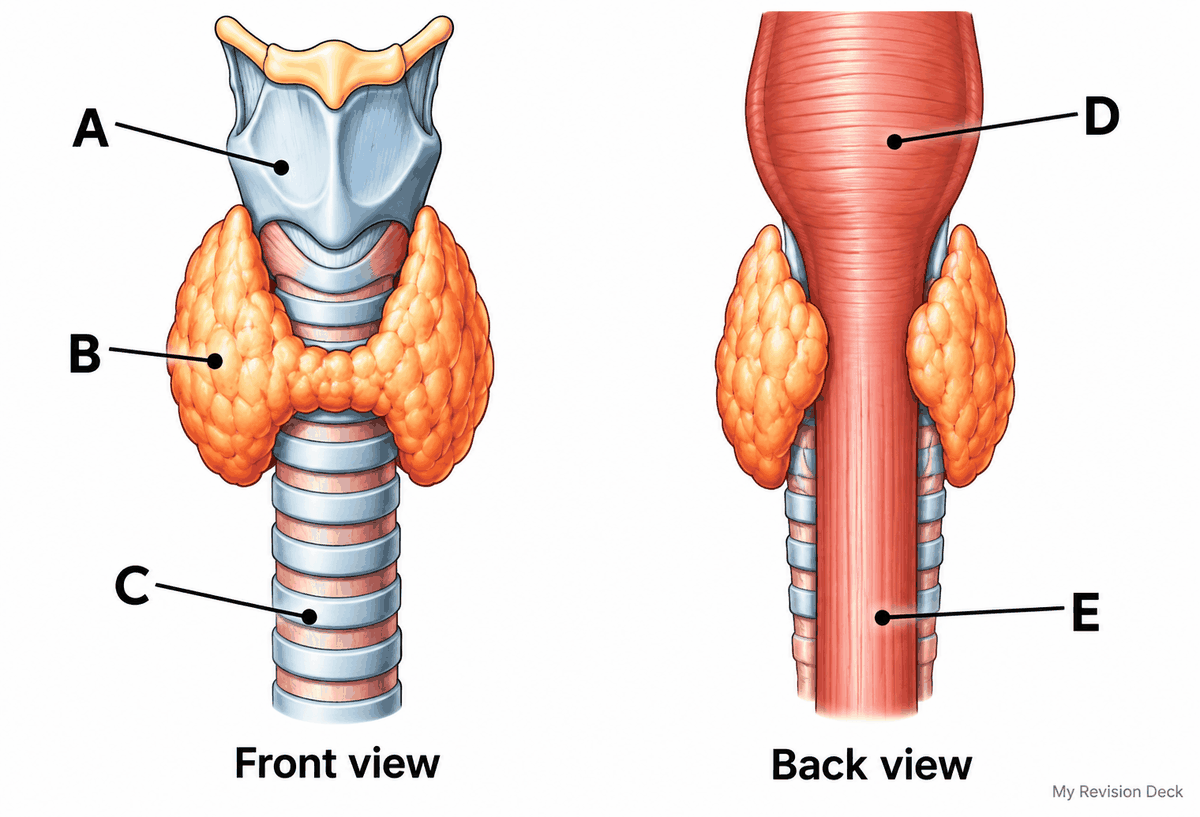
(i) Label A [1]
(ii) Label B [1]
(iii) Label C [1]
(iv) Label D [1]
(v) Label E [1]
Answer: (i) Larynx · (ii) Thyroid gland · (iii) Trachea · (iv) Pharynx · (v) Oesophagus
Question 2 · Short answer
Mention any four psychological changes that adolescents go through during this period. [2]
Answer: Adolescents become too conscious about themselves. They start worrying about the growth in various parts of their body. They feel shy and hesitant in sharing their problems with others. They sometimes develop depression because of the dramatic increase in hormone levels.
Other points a student may include: adolescents like to remain with their group of friends or peers most of the time, and try to imitate what others in their peer group do.
Biology mind map
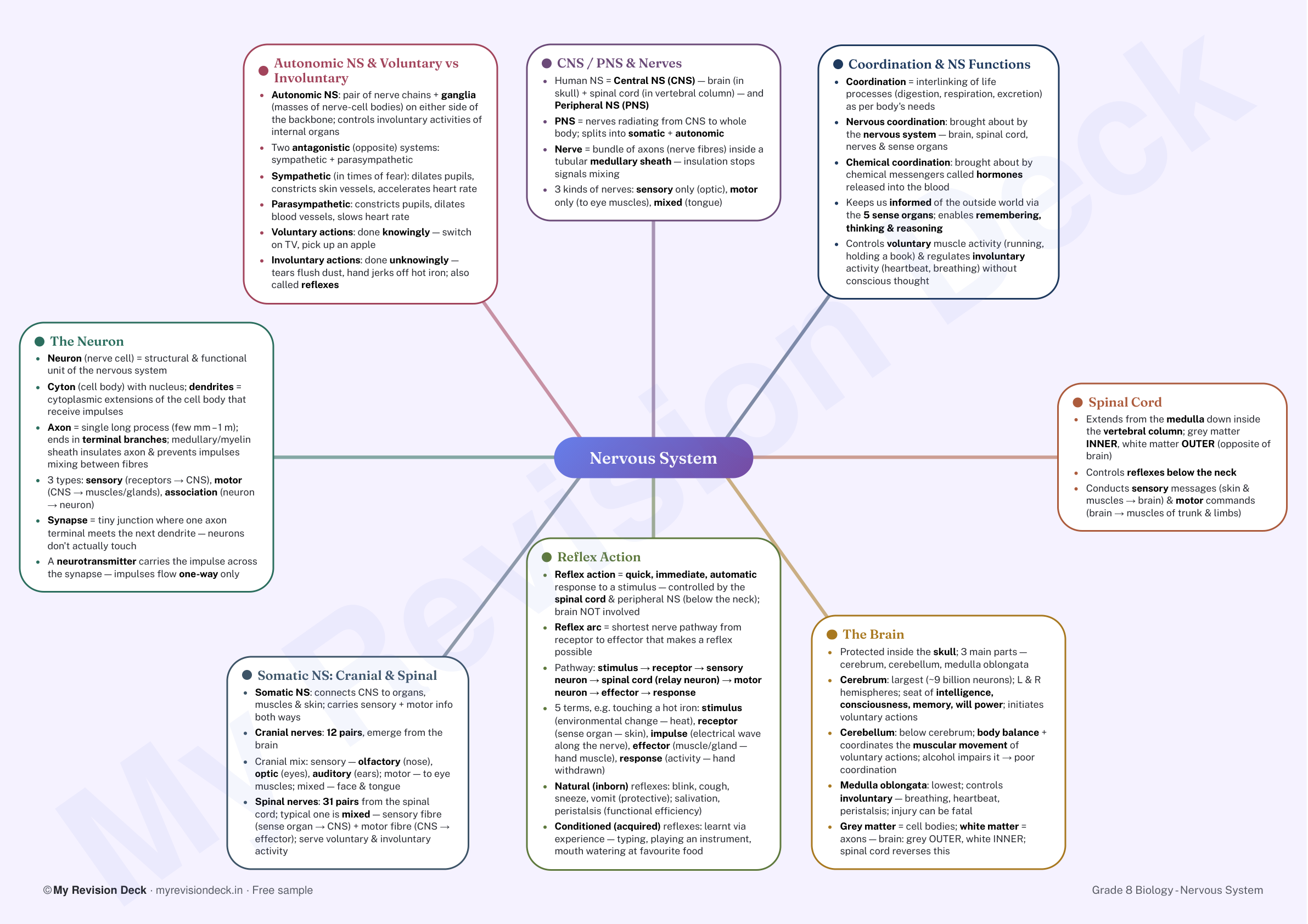
Nervous System · 1 page, A3, to print or keep on screen
PDF, 240 KB · 1 page, A3
Click the mind map to see it full size.