ICSE Class 8 Physics — Full Syllabus Sample Paper
A full-syllabus ICSE Class 8 Physics paper in the board pattern: 80 marks, covering every chapter. The answer key is a separate download, so you can print the paper for your child without the answers.
It's free so you can see the quality of our papers before you sign up.
Download the paper
Paper: PDF, 4.5 MB · Answer key: PDF, 6.6 MB · Updated for 2026–2027
A taste of the paper
Here are three questions from the paper. Download the full PDF for all 80 marks' worth.
Question 1 · Picture-based MCQ
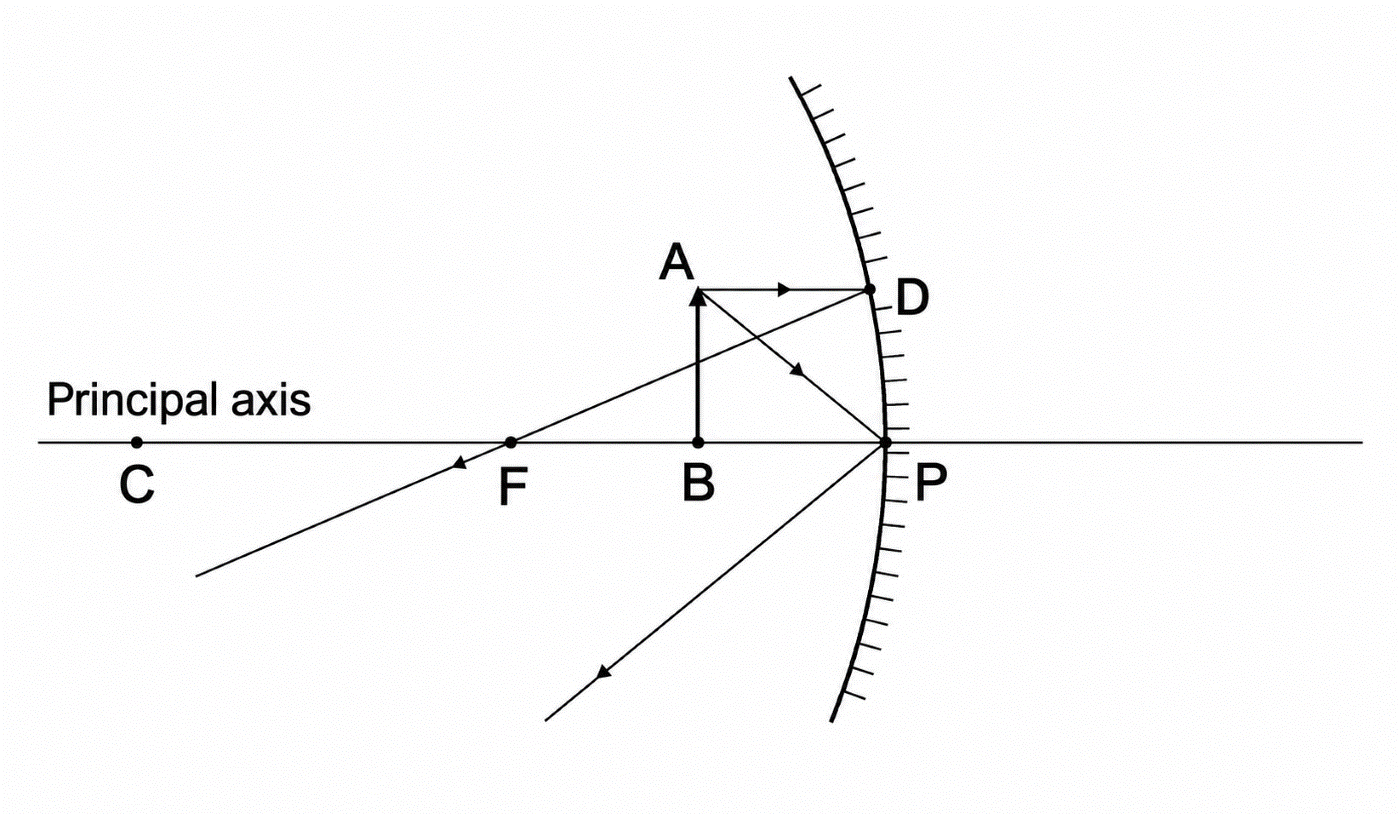
Observe the diagram showing two rays from the tip A of an object AB placed between the principal focus F and the pole P of a concave mirror, and the rays after reflection. Which of the given options best describes the image of AB formed by the mirror? [1]
Question 2 · Reasoning MCQ
Two coolies, A and B, lift the same load to the same height. Coolie A does it in 1 minute and coolie B does it in 2 minutes. Which of the following is true? [1]
Question 3 · Numerical
A piece of iron of mass 195 g is immersed in water taken in a Eureka can. It displaces 25 mL of water. Find the density of iron in kg m⁻³. [3]
Answer: Density = 7800 kg m⁻³.
Volume of iron = volume of water displaced = 25 mL = 25 cm³.
Formula: density = mass / volume.
Density = 195 / 25 = 7.8 g cm⁻³.
Conversion: 1 g cm⁻³ = 1000 kg m⁻³, so density = 7.8 × 1000 = 7800 kg m⁻³.
Want papers for any chapter combination?
Create a free account to generate Unit Tests and Term Papers tailored to exactly what your child has studied — with answer keys emailed to parents. Subscribers can also generate chapter worksheets.
Create a free account