ICSE Class 8 Chemistry — Full Syllabus Sample Paper
A full-syllabus ICSE Class 8 Chemistry paper in the board pattern: 80 marks, covering every chapter. The answer key is a separate download, so you can print the paper for your child without the answers.
It's free so you can see the quality of our papers before you sign up.
Download the paper
Paper: PDF, 3.8 MB · Answer key: PDF, 5.4 MB · Updated for 2026–2027
A taste of the paper
Here are three questions from the paper. Download the full PDF for all 80 marks' worth.
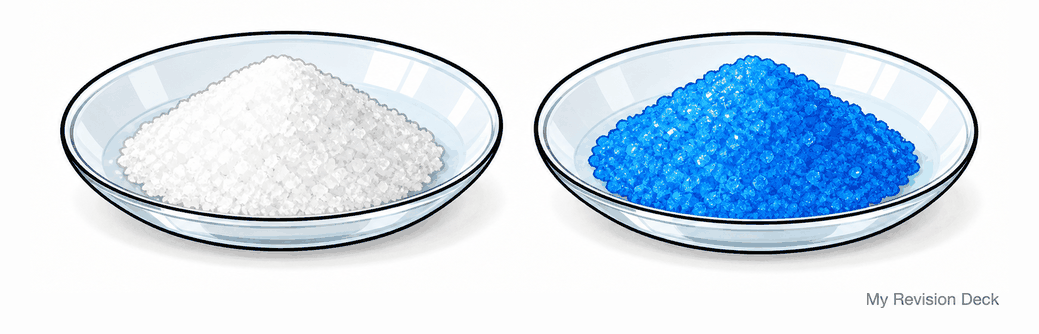
Question 1 · Picture-based MCQ
Observe the image showing two samples of copper sulphate side by side — one is white and the other is blue. Which of the given options best identifies the two samples? [1]
Question 2 · Application MCQ
Riya heats some sugar in a pan. First it melts into a clear syrup, then it turns brown and gives off a burnt smell. On cooling, the brown mass becomes hard. Which of these shows that a chemical change has taken place? [1]
Question 3 · Application question
Hot rice is packed in a steel tiffin box and the lid is closed. When the box is opened at lunch time, drops of water are seen on the underside of the lid. Name the two changes of state that have taken place and explain each of them in terms of the particles of water. [3]
Answer: The two changes are evaporation and condensation.
First, water evaporates from the hot rice: some of the water particles at the surface move fast enough to overcome the attraction of the neighbouring particles and escape as water vapour into the closed box.
Then condensation takes place at the lid, which cools faster than the rice: when the vapour touches the cooler lid, it loses heat, its particles lose energy and slow down, and they come close together again to form drops of liquid water on the underside of the lid.
Want papers for any chapter combination?
Create a free account to generate Unit Tests and Term Papers tailored to exactly what your child has studied — with answer keys emailed to parents. Subscribers can also generate chapter worksheets.
Create a free account